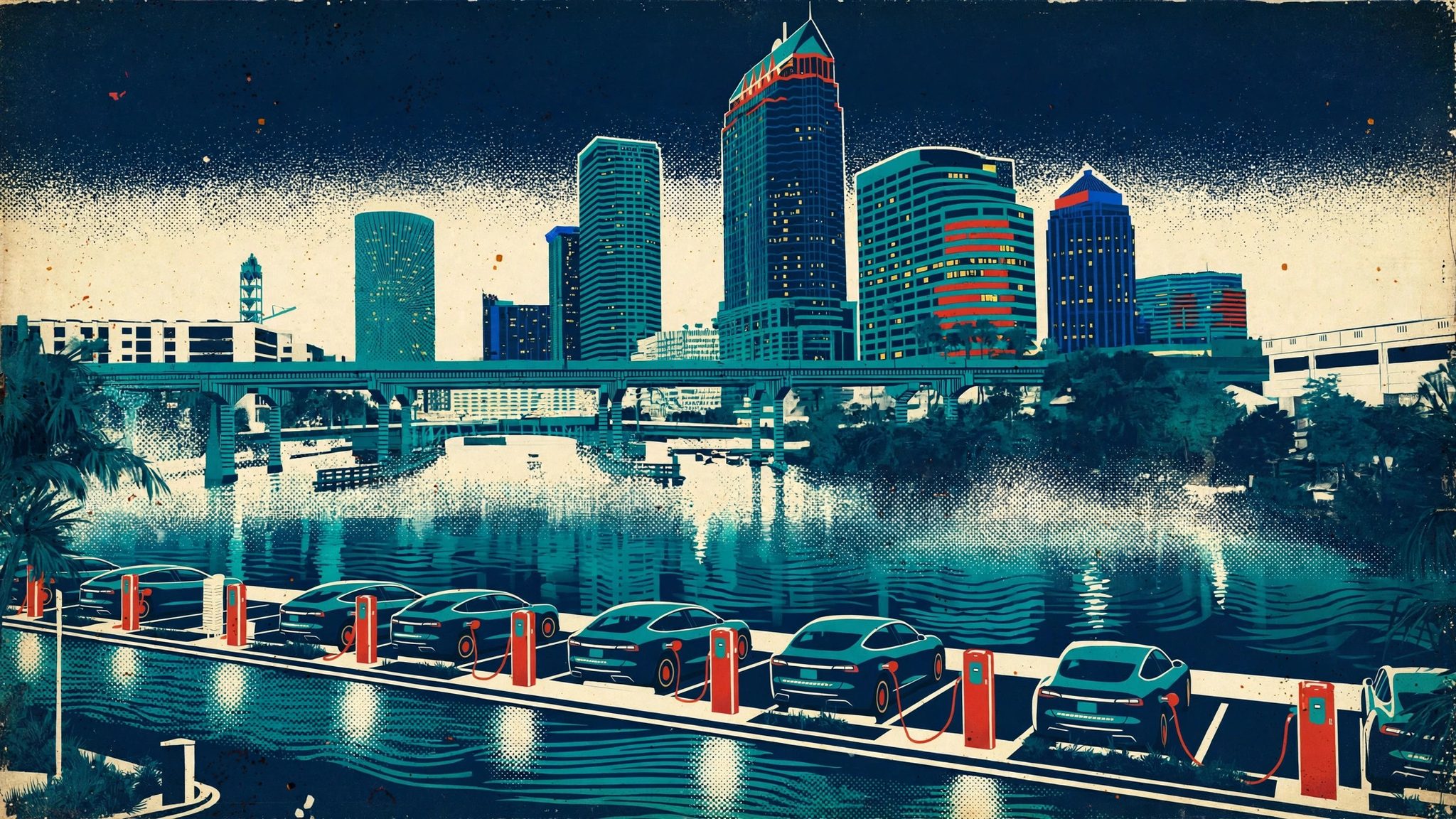
Nobody announced it. There's no mandate here, no state rebate, no big campaign. Tampa Bay just keeps plugging in — and the registration numbers say fully electric cars are taking over our roads faster than almost anywhere else in the country.
A quick note on what counts here: this is about battery-electric vehicles — cars with no gas engine at all. No oil changes, no exhaust system, a fraction of the moving parts. Plug-in hybrids still carry a gas engine and everything that comes with it, so they're a different story, and mostly not this one.
Where we stand
Statewide, Florida had 450,400 battery-electric cars registered through 2025 — up about 77% in just two years — ranking #2 in the nation, behind only California. Florida got there without California-style incentives.
Here in the Bay area, the most recent registration data works out to roughly 56,000 fully electric cars across our three counties:
That's on top of what U.S. Department of Energy data already showed back in 2023 — more than 42,000 battery-electrics in the Tampa Bay area — and the count has only climbed since. (County-level figures are estimates; the state doesn't publish an exact county-by-county BEV count. The statewide numbers above are exact.)
And Tampa Bay drivers aren't hedging. Across Florida, pure battery-electrics outnumber plug-in hybrids about five to one. When people here go electric, they go all the way.
How fast did this happen?
In 2020, Hillsborough and Pinellas counties combined had 4,576 battery-electric cars. Today those same two counties are at roughly 45,000 — about ten times as many in five years, during a stretch that included a pandemic, high interest rates, and the end of the federal EV tax credit.
Whatever is driving this, it isn't a fad and it isn't a subsidy. People drive one, do the math on what it costs to run, enjoy never visiting a gas station or an oil-change bay again — and don't go back.
The charging has had to keep up: Hillsborough County alone now has more than 1,100 charging stations, with fast chargers along every major corridor in the Bay area.
What happens next?
Battery-electrics are still a small slice of everything on the road — about 2.3% of Tampa Bay's vehicles. But slices compound. Florida's electric fleet grew about 33% a year over the last couple of years; even if that pace cools as the numbers get bigger, simple math says fully electric cars could be around 20% of the vehicles on Tampa Bay's roads by roughly 2034. (That's a projection, not a promise — growth always slows as it scales. But the direction isn't really in doubt.)
The showroom version comes sooner: EVs were already about 10.5% of new cars sold in Florida in mid-2025, so one in five new cars sold being electric is likely a ~2030 story. The cars on the road just take longer to turn over — a gas car bought today will still be driving around in 2038.
Why it matters if you don't drive one (yet)
Every one of those 56,000 cars belongs to a neighbor who can tell you what it's actually like — what the electric bill did, what road trips are like, what they save skipping oil changes and brake jobs. That's worth more than any advertisement, including anything on this site. And as the fleet grows, so does everything around it: more chargers, more mechanics who know these cars, and a bigger, cheaper used market for the next buyer.
Tampa Bay isn't waiting to go electric. By the registration data, it's already well on its way — quietly, one driveway at a time.
About the numbers & sources
Statewide battery-electric figures are exact counts from the U.S. Department of Energy. County figures are estimates built from Drive Electric Florida / Orlando Utilities Commission registration data through late 2025 and the statewide electric mix; historical figures come from a U.S. DOE–funded USF/NREL Tampa Bay study.